

From nectar to food reserve
Honey begins with nectar. Flowers secrete this sugar-rich liquid to attract pollinators. A forager stores it temporarily in her honey stomach. During the return flight, enzymes are added and the composition begins to change.
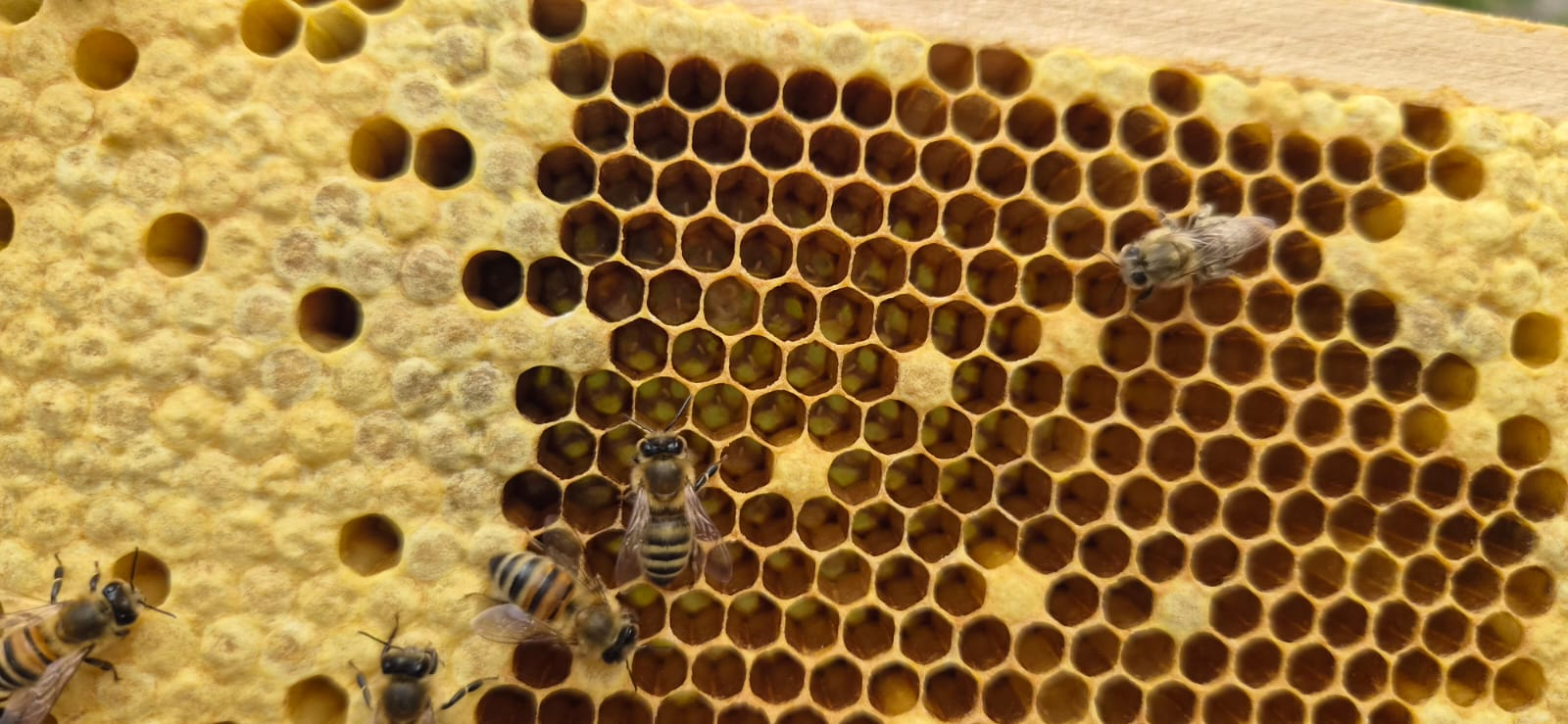
Back in the hive, the forager passes the nectar to house bees. They process it and place it in the comb. Fresh nectar still contains a great deal of water. The bees repeatedly spread the liquid over their mouthparts and ventilate the hive with their wings. Water evaporates and the contents become thicker. Only when the honey is sufficiently concentrated do they close the cell with a thin wax cap. It is then a stable food reserve for periods when little can be gathered outside.
The comb where everything comes together
The hexagonal cells are made from beeswax. Young workers produce tiny wax scales under their abdomen, knead them with their jaws and build the comb. Hexagons fit together without gaps and create a strong structure with relatively little material.
Comb also stores pollen and provides cells for raising brood. It is the colony’s central working surface. The bees explains more about the colony’s development through the seasons.
From capped comb to jar
The beekeeper harvests only ripe honey. Capped cells are an important sign, but moisture content also matters because wet honey can ferment. Under the European Honey Directive, ordinary blossom honey may generally contain no more than twenty per cent water.
The wax caps are removed and the frames are spun. Centrifugal force draws honey from the cells. It is strained to remove larger wax particles and left to settle, allowing bubbles and fine wax to rise before it is filled into clean jars.
Raw, heated and filtered
Raw honey is not a separate legal product category under European honey rules. It usually means honey that has not been strongly heated after harvesting and has only been lightly strained.
Heating can liquefy crystallised honey and simplify processing, but excessive or prolonged heat damages enzymes and aroma. Very fine filtration can remove almost all pollen. Ordinary straining, which catches wax while largely retaining pollen, differs from the legally defined category of filtered honey.
Blossom honey and other types
Blossom honey is made from floral nectar. Honeydew honey mainly comes from sweet secretions left on plants by insects. If one plant clearly dominates the nectar supply, honey may be described as lime, acacia or rapeseed honey. Blossom honey is a logical name for mixed local forage.
Nectar sources, weather and harvest time influence colour, aroma, flavour and crystallisation. Honey from the same apiary can therefore differ from year to year. Landscape and forage shows which plants around Wijk bij Duurstede may play a part.
Why honey is sometimes runny and sometimes firm
Crystallisation is natural and not a sign of spoilage. Honey consists mainly of glucose and fructose. Glucose is less soluble and can form crystals over time. Temperature, fine particles and the balance between sugars affect the speed and texture.
Runny and creamed honey are not necessarily different kinds. Creamed honey is stirred under controlled conditions so that many small crystals form. Coarsely crystallised honey can be gently liquefied in a warm water bath; strong heating is unnecessary.
Is honey healthy
Honey contains small amounts of substances other than sugars, but too little to be an important source of vitamins or minerals. Nutritionally, it remains primarily a sugar-rich food. The body does not process its glucose and fructose fundamentally differently because they come from honey.
Honey can still form part of a normal diet. Its flavour means a small quantity is often enough. It is sensible to regard it as a sweetener, not a health product. The value of local honey lies mainly in known origin, a short supply chain and its connection with the landscape. The Netherlands Nutrition Centre advises using honey, like other free sugars, in moderation.
Babies under one year must not be given honey because it may contain spores that cause infant botulism. This specific risk normally does not affect older children and adults.
Do not put table honey directly on a burn
Medical-grade honey is sometimes used in wound care, but it is a standardised and controlled medical product. Honey from a jar is not sterile and is unsuitable for applying to a burn or open wound. Cool a burn immediately for twenty minutes with lukewarm, gently running tap water and seek medical advice.
Storage and use
Store honey tightly closed, dry and at a stable room temperature. Refrigeration is unnecessary and often speeds crystallisation. Always use a clean, dry spoon.
Honey can sweeten yoghurt, dressings, marinades, cakes and hot drinks. Its flavour is clearest when it is not cooked for a long time. In baking it adds colour and moisture, but does not always replace sugar one for one because it also contains water.
Sources
This article was checked against information from the Netherlands Nutrition Centre, the European Honey Directive, Thuisarts, Cochrane and Imkerij Bij de Stad.